

Vampire Crawlers Review: The Anti-AFK Roguelike
Vampire Survivors was brilliant until you stopped touching the controller. That moment when your build auto-piloted through 20 minutes of fireworks felt empty. Vampire Crawlers fixes that by forcing your hands to stay busy. It's a deck-building roguelite that keeps the pixel-art soul but replaces idling with actual decisions.
I played on Xbox Series X for this review, sinking about 18 hours across multiple runs. Here's where it shines and where it stumbles.
What Vampire Crawlers Does Differently
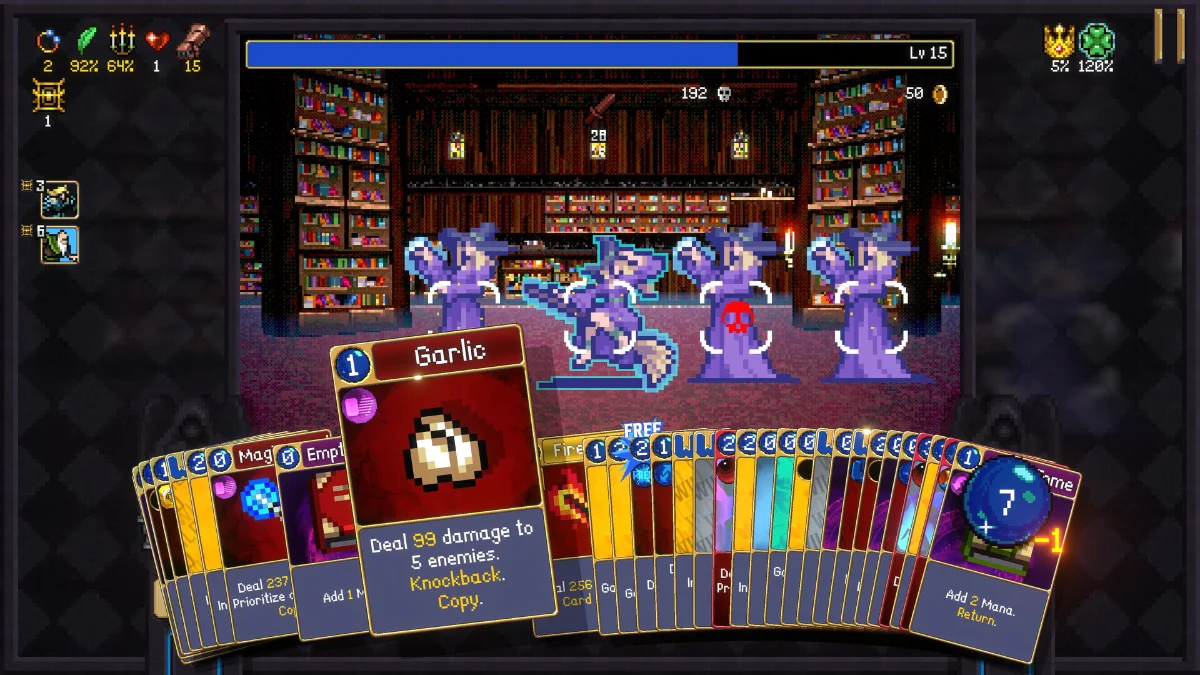
You pick a Crawler, each with a starting deck and passive ability. Then you navigate first-person dungeon floors, moving block by block. Combat triggers encounter screens where enemies stack in rows. Your mana pool starts at three. You play cards in ascending cost order to trigger combos. A zero-cost card boosts a one-cost, which boosts a two-cost, and so on.
This sequencing rule changes everything. In most deck-builders, you dump your best cards whenever. Here, order determines damage multipliers. A poorly sequenced hand does half the work of a smart one.
Cards are familiar Vampire Survivors weapons: whip, fire wand, knives, garlic. They hit single targets or entire rows. The Turbo Turn option speeds up resolution without breaking damage order. Full-board clears resolve in seconds.
Where the system sings

The magic appears once you unlock gems and multiple Crawlers. Gems slot into cards, adding effects. An Attractorb gem on a Knife card means the knife also pulls experience orbs. A Wildcard gem lets you play any card at zero mana, restarting your combo chain mid-turn.
Then you add second and third Crawlers as passives. Each has a trigger condition: play a red attack card and the Skeleton fires bones. Play a blue defense card and the Golem adds armor. These triggers stack per turn. Suddenly you're sequencing not just mana costs but colors, hoping to proc three different passives in one combo.
"In one of my earliest runs I had a two mana card that granted me three mana for playing it. I added gems that made it draw a bonus card and create a copy of itself in my hand. Suddenly battles were over before they began."
- Reddit u/codhimself
That flexibility kept me running "one more" for hours. In one run I stacked experience gain and overleveled. In another I combined Attractorb and Tome cards to extend turns indefinitely. In a third I used Bone cards to wipe four enemy rows in a single combo.
The Slow Opening (And Why It Hurts)
The first few hours are misleading. Your hand caps at five cards. Enemy difficulty is low. The optimal play is almost always 1-2-3 in order. There's no real choice. You're just counting.
This is the game's biggest flaw. Reviewers on PC Gamer gave it a 50/100 partly for this reason. One Reddit user said they almost refunded after an hour. I don't blame them.
But around hour four, things change. You buy the hand-expansion upgrade at the village hub. You unlock Wildcards. Enemy packs get bigger and row density increases. Suddenly the game asks: do you play your zero-cost now to start a short combo, or hold it to bridge a higher chain later? Do you take that spicy damage buff or the card draw?
The question becomes whether you're willing to wait through that slow ramp. Some players won't. That's valid.
Village progression and the gold grind
Gold collected in runs buys permanent upgrades: extra mana, more hand size, drop rarity manipulation, healing between floors. These gate progress. I hit a wall around 11 hours that required grinding specific bridge levels for gold. I reached credits at 18 hours.
A successful run takes about 40 minutes. Early runs unlock five or more items each. That thins out dramatically later. Some Reddit users called the grind excessive. One wrote:
"I finished Crawlers in ~10 hours. It got boring quite sooner. There are no 'builds.'"
- Reddit u/Evershifting
I disagree about the builds claim. But the grind criticism is fair. The game asks for patience.
Visuals, Voice Acting, and Jank
Stage layouts return from Vampire Survivors: Mad Forest, Inlaid Library, Dairy Plant. They're rebuilt in 3D rather than redrawn. Pixel art enemy sprites pop against the new depth. Attack effects fill the screen with knives, fireballs, and dancing cats.
Crawlers speak short lines when selected. It's fine. You won't miss it if you turn it off.
The movement is stiff. Navigating the 3D grid feels clunky, even with relics that reveal hidden items. The mini-map shows every enemy, chest, and breakable on the floor. That removes exploration tension. You just take the shortest path to the boss.
Also: the hand does not sort automatically. Once you have eight cards, they compress on screen. You can drag them but cannot sort by mana cost or color. Balatro offers this basic feature. Vampire Crawlers does not.
Who Is This For?
If you bounced off Slay the Spire for being too slow or math-heavy, Vampire Crawlers might click. It's faster, flashier, and less punishing. The permanent upgrades mean you always make progress, even on failed runs.
If you want deep synergy puzzles and tight balance, Slay the Spire 2 or Monster Train 2 are better bets. One Reddit user put it bluntly:
"It's a deckbuilder for people who don't really care about depth or strategy. I played 6 hours and it doesn't really go anywhere interesting."
- Reddit u/ThinEzzy
I think that's too harsh. The depth becomes real around hours 5-8. But the game buries it behind grind and a slow tutorial disguised as early progression.
Bottom Line
Vampire Crawlers is a 7/10 game wearing a 9/10 demo. The core loop of mana-sequencing, gem slotting, and multi-Crawler passives is genuinely smart. When it clicks, you feel like a genius. The problem is how long it takes to click.
Poncle didn't play it safe. A direct Vampire Survivors sequel would have sold millions. Instead they built a deck-builder from the ground up. That deserves respect. But respect doesn't erase the first four hours of arithmetic.
If you love Vampire Survivors and want more interaction, buy this. If you have zero tolerance for gold grinding or manual hand sorting, wait for a patch.
Version tested: Xbox Series X | S. Also available on PS5, Nintendo Switch, PC. Mobile ports coming soon.
Frequently Asked Questions
Is Vampire Crawlers better than Vampire Survivors?
How long does it take to beat Vampire Crawlers?
Is Vampire Crawlers on Steam Deck?
Does Vampire Crawlers have multiplayer?
How does the combo system work in Vampire Crawlers?
What platforms is Vampire Crawlers available on?
Sources
- videogameschronicle.comhttps://www.videogameschronicle.com/review/vampire-crawlers-review/
- cbr.comhttps://www.cbr.com/vampire-crawlers-review-best-roguelike-2026/https://www.gamespot.com/reviews/vampire-crawlers-review-pixel-perfect-pandemonium/1900-6418483/
- egw.newshttps://egw.news/gaming/news/34241/vampire-crawlers-review-a-deckbuilder-with-delayed-sIOWqseKb